Should You Force New Pricing on Your Sales Team or Bring Them Along?
Karim Benzakour
Karim is the founder and lead consultant of KABEN Partners. He advises B2B and private equity-backed companies on pricing strategy, price increases, and pricing roll-outs, from the first audit to the moment new prices hold in every deal.
LinkedIn
Facebook
Twitter
WhatsApp
Email
At the start of a recent engagement, the CSO of a private equity-backed B2B software company asked me a direct question: “When the new pricing is ready, do we force the sales team to apply it, or do we bring them along?”
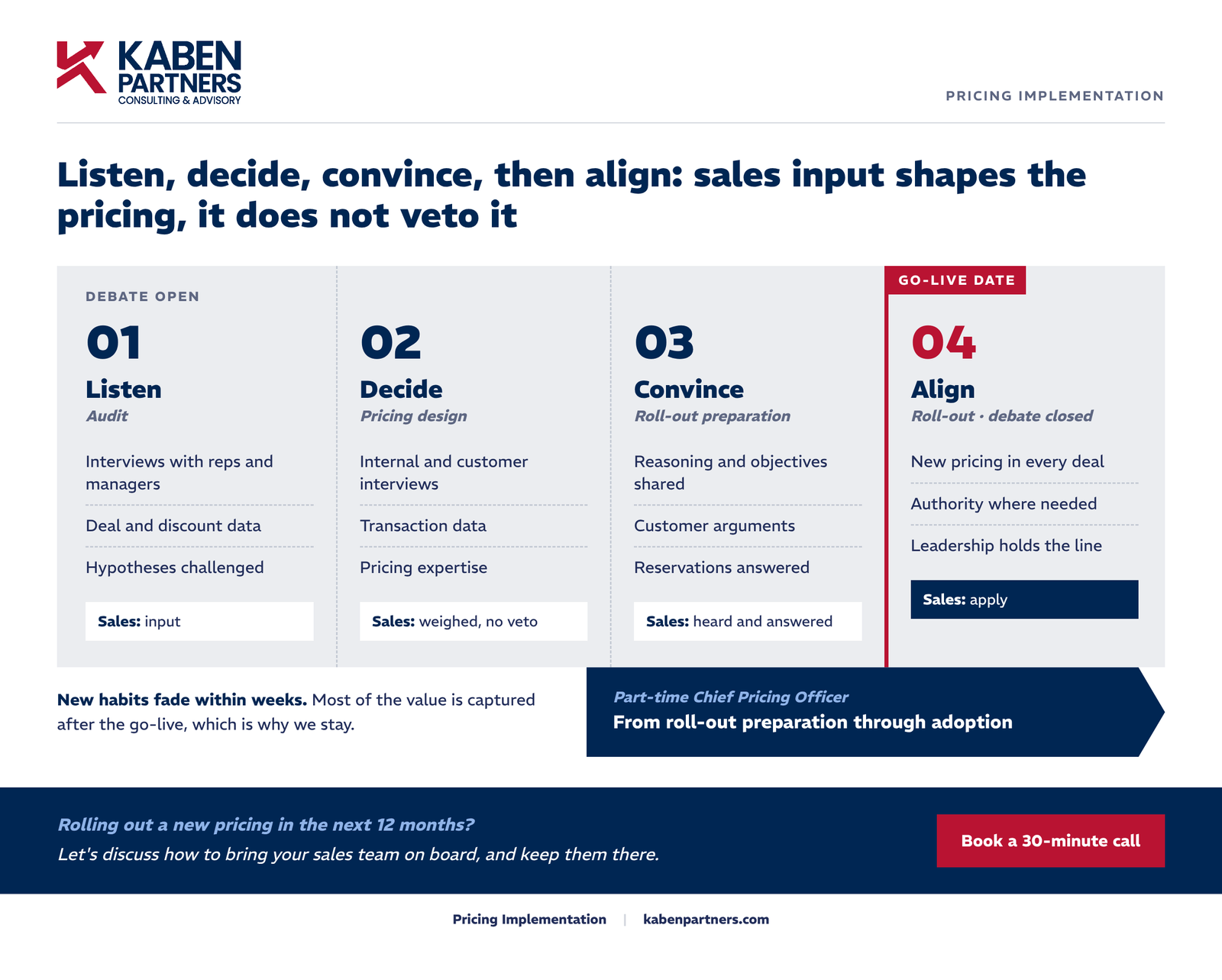
My answer, after many pricing engagements: you do both, but not at the same time. You listen to sales early, because they know things the data does not. You decide on evidence, not by consensus. You then spend real effort convincing them, because a convinced salesperson sells a price very differently from one who is not. And you set a date after which the new pricing applies, whether or not everyone agrees. If you wait for every salesperson to be on board, some never will be, and the project never goes live.
Step 1: Listen to sales during the audit
Every pricing engagement I run starts with interviews: sales reps, sales managers, customer success, finance. Sales teams are the people closest to the customer, and they regularly point me to things no dataset shows: which segments really compare offers, which features customers never use, where a competitor is quietly undercutting, which part of the price list makes quotes hard to build.I have changed my view more than once after these conversations. A hypothesis that looked solid in the transaction data fell apart when a sales manager explained how deals were actually structured. Listening to sales is never a courtesy. It makes the final pricing better.
Step 1 · Listen
Listening to sales is not a courtesy. It makes the final pricing better.
KABEN Partners
Step 2: Listen to the market, because price matters less than sales teams think
Listening to sales is necessary, but it is not sufficient. In almost every engagement, I hear the same story from the sales floor: customers are extremely price-sensitive, they are squeezed, and we have to sacrifice price and margins to close. Then I interview the customers. Most of the time, they talk about reliability, service, ease of use, switching costs and risk. Price matters, but rarely as much as the sales team believes.This is not just my impression. Research points in the same direction:
A survey of B2B salespeople found that over 70% will cut their price if the buyer asks for a discount, even when the buyer acknowledges the offer is better. The same research found that buyers would pay around 9% more for a solution that saves them time or money.
A peer-reviewed study of 537 sales negotiations, published in the Journal of Retailing, found that salespeople misjudge how important price is to their customers because they rely on misleading cues. Those who read it accurately granted significantly smaller discounts without hurting the customer’s intention to buy.
Why does this happen? Salespeople hear price objections every day and remember the deals they lost. Procurement teams are trained to make price look decisive. And asking for a discount costs the buyer nothing. The result is a distorted picture, sincerely held, that systematically overstates price sensitivity.
Why sales teams should not set prices
Pricing is a profession. Selling is a totally different one. Good salespeople build relationships, understand needs, and close deals. Setting prices requires something else: segmentation, value measurement, competitive analysis, margin modelling, and consistency across thousands of quotes.Academic research supports this. A study published in the Journal of Marketing found that firms giving salespeople the highest degree of pricing authority had the lowest sales and profit results. A more recent Journal of Marketing study of B2B firms adds an important nuance: medium levels of delegation work best, and profitability is higher when pricing authority is shared across sales, marketing and finance rather than left to one function. In other words, sales should have bounded room to adapt a deal, not the power to set the price.When sales teams effectively own pricing, I see the same symptoms in mission after mission:
Unexplained price gaps. In one recent engagement, similar customers were paying anything from one to three times the same price, with no clear justification.
More negotiation inside the company than with customers. Reps spend their energy negotiating discount approvals with their managers instead of negotiating value with the buyer. The internal process rewards the person who argues best for a lower price.
Incentives that make discounts cheap. When commission tracks revenue, a 5% discount barely changes the rep’s pay but can wipe out a large share of the deal’s profit.
The consequence is predictable. Margin erodes first. Then revenue follows, because discounted prices become the new reference at every renewal. Price is the most powerful profit lever a company has, and this is where most of it leaks.
Who sets the price
Pricing is a profession. It is not the same profession as selling.
KABEN Partners
Step 3: Decide, using sales input but not a sales vote
The pricing design phase combines four sources: what sales and internal teams told us, what customers told us, what the transaction data shows, and pricing expertise built across many engagements. Sales feedback weighs in the decision. It does not hold a veto.This is also where the supporting system is set: sales incentives that reward margin and price realisation as well as volume, and clear guardrails on discounts, with escalation levels and approvals. These mechanisms are necessary. On their own, they are not enough.
Step 3 · Decide
Sales feedback weighs in the decision. It does not hold a veto.
KABEN Partners
Step 4: Convince during implementation, with a go-live date already in mind
Once the decisions are made, the goal is to convince, not to renegotiate. At the end of the design phase and throughout implementation, we explain to the sales team:
the reasoning behind each decision and the data that supports it;
the objectives for the company and what changes for the customer;
how to present the new pricing, with customer arguments, answers to the most common objections, and practice sessions.
We keep listening. Reservations are heard and answered, and sometimes they lead to adjustments in how the pricing is presented or rolled out. But everyone knows from day one when the new pricing will apply.Conviction matters because customers can tell the difference. A salesperson who believes in the price presents it calmly and moves on to value. A salesperson who does not believe in it presents it apologetically, as if negotiating on tiptoe, and the buyer immediately understands there is room to push.Unconvinced salespeople do not stay neutral. Those who oppose the new pricing will put more energy into making it fail than into making it work. And if they sense hesitation, even among the leaders who decided it, they will bet that a few weeks or months of weak sales will be enough to force a U-turn without changing their habits. This is why the decision must be explained with conviction and then held.
Step 4 · Convince
A convinced salesperson sells the price. An unconvinced one negotiates it away.
KABEN Partners
Step 5: After the go-live date, alignment is not optional
Change is painful. It is especially true in the workplace. Change management practitioners often refer to the 20/60/20 rule of thumb: in any major change, around 20% of people embrace it quickly, 60% follow once convinced, and 20% resist. It is not a scientific law, but my pricing engagements show the same pattern. A group of salespeople, often the most tenured, keeps returning to the pricing habits and mechanisms they have always had, whatever the training. Even if those habits are suboptimal and ultimately cost money.That cannot be allowed to stall the project. From the go-live date, the message is clear: “We heard your concerns. We took them into account. We have decided, based on a holistic approach, and now we move forward together.” The new pricing applies to every customer conversation. Where conviction fails, authority takes over: guardrails are enforced, exceptions follow the approval process, and leadership does not undo the policy when a key account calls the CEO to ask for an extra discount.
Step 5 · Align
If you wait for every salesperson to be on board, you will never go live.
KABEN Partners
The private equity shortcut. Some investors, under time pressure, skip this step and replace part of the sales team with people who already sell on value. It can work, but it is expensive: recruitment, ramp-up time, and, above all, customer relationships that leave with the people. In software, where the installed base drives recurring revenue, that risk is real. I prefer to give people the time to align with a clear limit. Most of them do.
Why implementation needs support over time
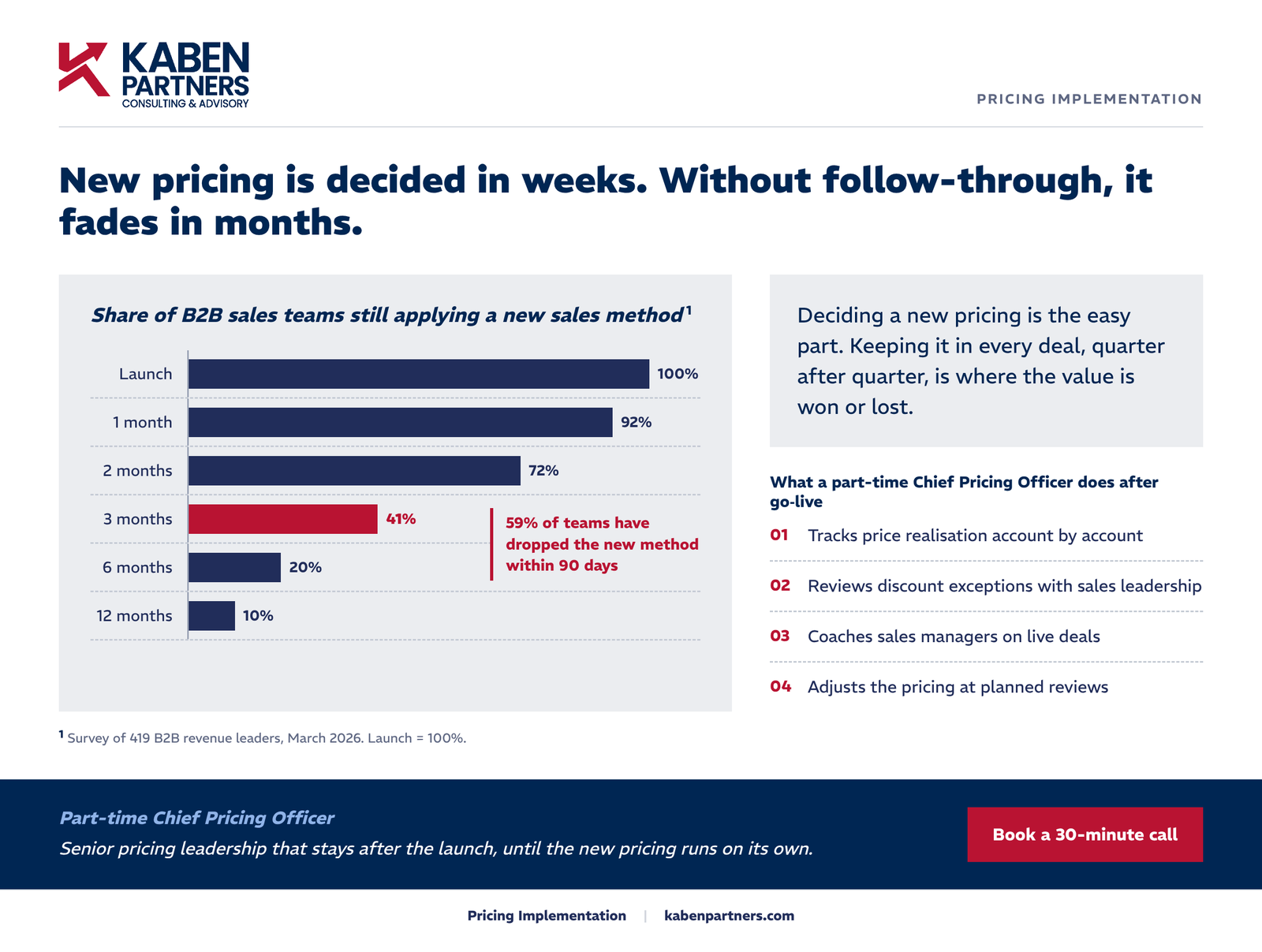
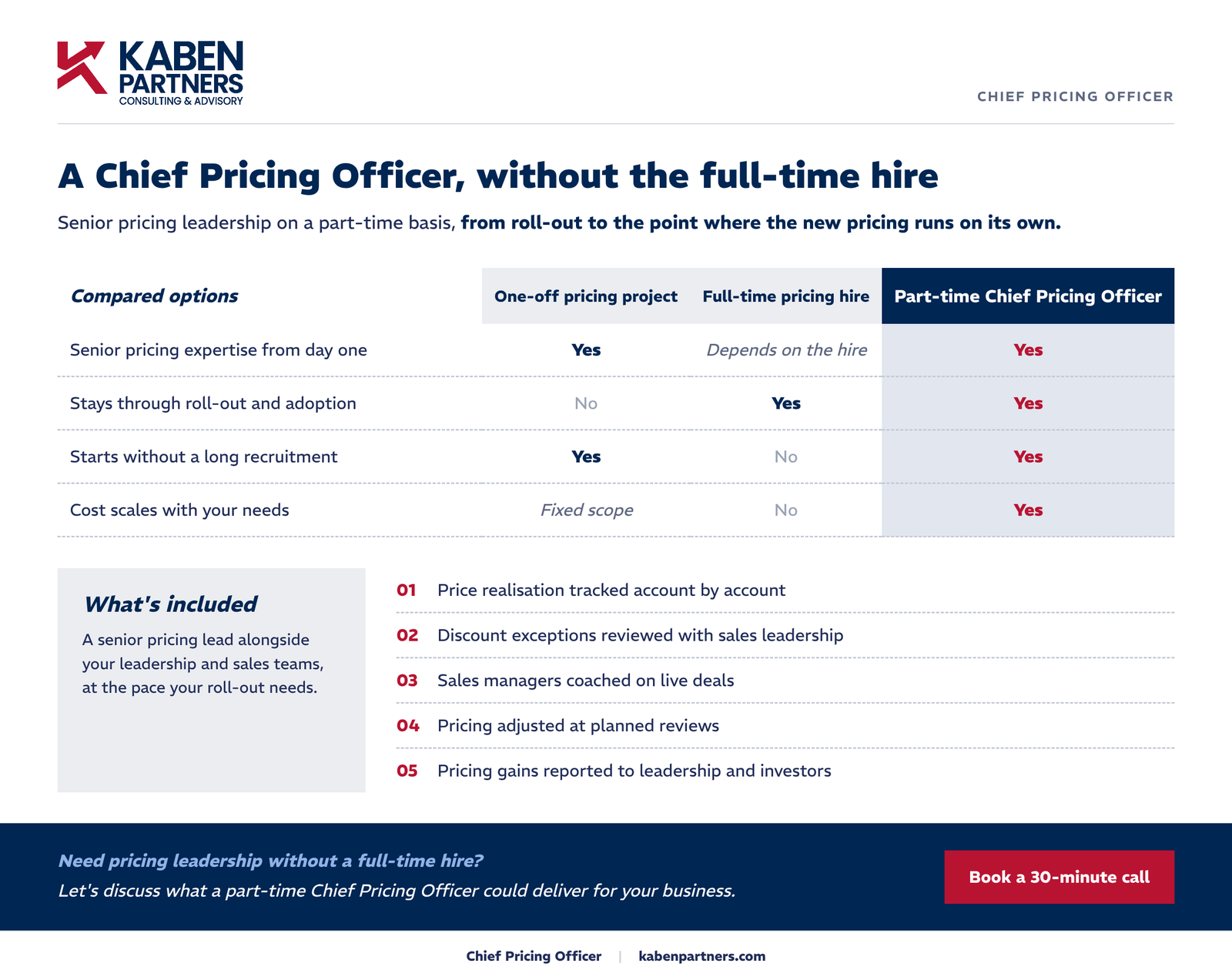
Deciding on a new pricing takes weeks. Getting it into every deal takes months. A 2026 survey of 419 B2B revenue leaders found that 59% of new sales methods fade within 90 days of launch, and only one team in ten is still applying them a year later. Pricing is no exception: without follow-up, old discounting habits return, one exception at a time.This is why I do not stop at the recommendations. As a part-time Chief Pricing Officer, I stay alongside the leadership and sales teams through the roll-out and beyond: tracking price realisation account by account, reviewing exceptions with the deal desk, coaching managers, and adjusting the pricing at planned intervals.Above all, a pricing expert provides the backbone the change needs to hold its course. That means saying no when it matters: to sales requests that would reopen the decision, but also to management when a call is not reasonable or no longer serves the objectives it set itself. It also means having the right arguments ready when the sales team pushes back, so the direction stays clear. Listening does not stop. What stops is renegotiating the decision deal by deal.
Support over time
Deciding a new pricing takes weeks. Getting it into every deal takes months.
KABEN Partners
Key takeaways
Listen to sales early. Their field knowledge improves the pricing.
Check what they say against the market. Internally, price sensitivity is almost always overestimated.
Do not let sales set prices. Pricing is a different profession, and full sales autonomy on price destroys margin.
Convince before you impose. A convinced salesperson sells the price; an unconvinced one negotiates it away.
Set a go-live date and hold it. If you wait for unanimous agreement, you will never go live.
Support the change over time. New behaviours fade within weeks without follow-up.
Frequently asked questions
Should salespeople have pricing authority?
Limited authority, yes. Research on B2B firms shows that moderate delegation works best: salespeople can adapt a deal within defined price corridors, while list prices, discount policies and larger exceptions are decided by a pricing function working with sales, marketing and finance.
How do you get a sales team to accept new pricing?
Involve them early by listening to their feedback during the audit, explain the reasoning and data behind the decisions, give them the tools to present the pricing to customers, and set a clear go-live date after which the new pricing applies to everyone.
What if some salespeople still disagree after go-live?
Keep listening and track results, but do not reopen the decision deal by deal. Enforce the guardrails and approval process, and make sure leadership supports the policy when customers push back.
What does a part-time Chief Pricing Officer do?
A part-time Chief Pricing Officer brings senior pricing expertise without a full-time hire: they steer the roll-out of a new pricing, track price realisation, govern discount exceptions and coach sales managers over several months, until the new practices are embedded.