Should You Force New Pricing on Your Sales Team or Bring Them Along?
Karim Benzakour
Karim is the founder and lead consultant of KABEN Partners. He advises B2B and private equity-backed companies on pricing strategy, price increases, and pricing roll-outs, from the first audit to the moment new prices hold in every deal.
LinkedIn
Facebook
Twitter
WhatsApp
Email
At the start of a recent engagement, the CSO of a private equity-backed B2B software company asked me a direct question: “When the new pricing is ready, do we force the sales team to apply it, or do we bring them along?”
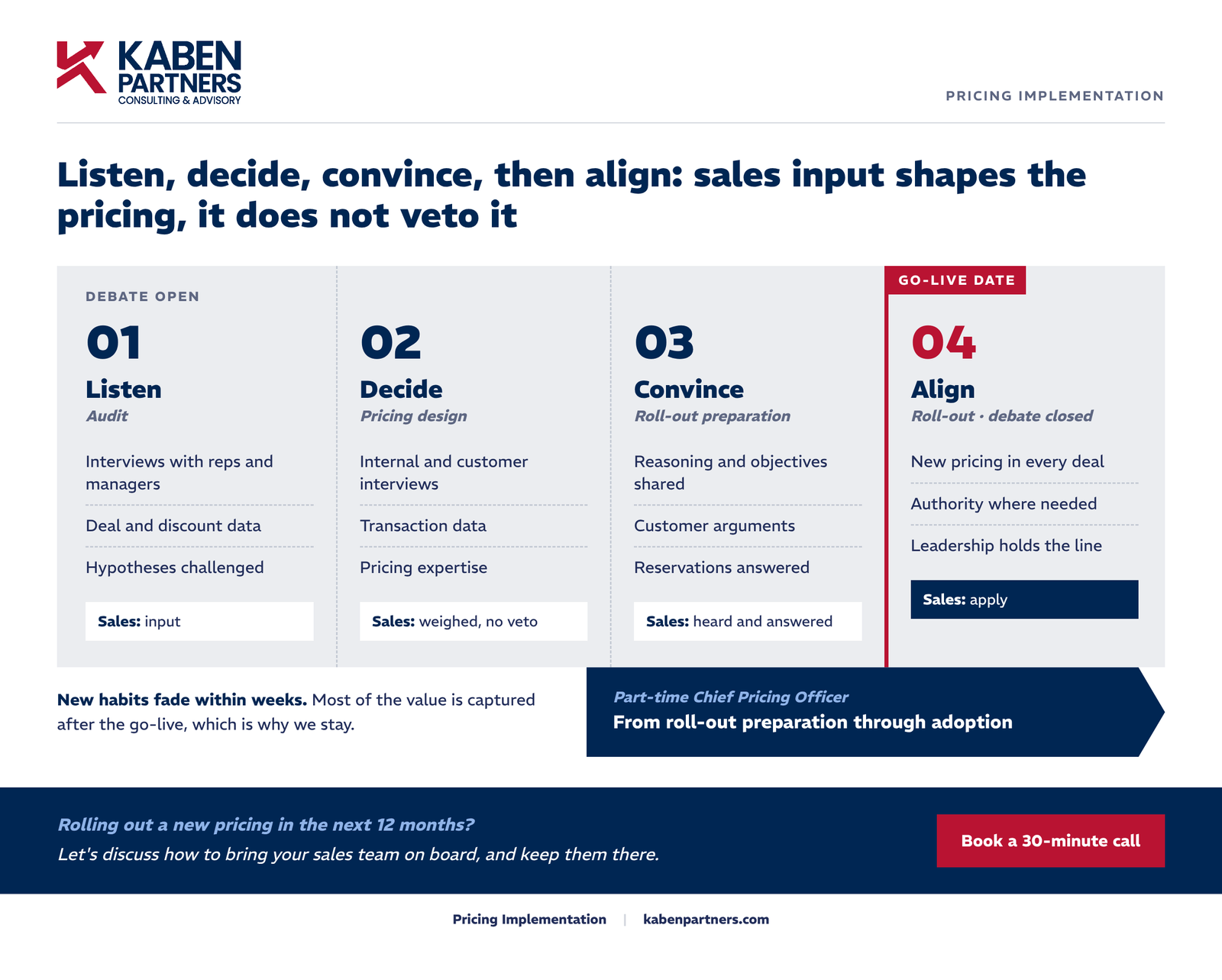
My answer, after many pricing engagements: you do both, but not at the same time. You listen to sales early, because they know things the data does not. You decide on evidence, not by consensus. You then invest real effort in convincing them, because a convinced salesperson sells a price very differently from one who is not. And you set a date after which the new pricing applies, whether or not everyone agrees. If you wait for every salesperson to be on board, some never will be, and the project never goes live.
Pricing is not a consensus exercise
Pricing sits at the crossroads of functions that pursue different objectives. Finance looks at margin and cash, marketing at positioning and demand, sales at closing the deals in front of them this quarter. It is normal, and healthy, that a pricing project seeks to bring these perspectives together. But bringing perspectives together is not the same as reaching unanimous agreement.
The optimal pricing decision is not the one that generates consensus. It is the one that moves the company towards its high-level objectives: revenue, margin and customer lifetime value. Some of those decisions will be unpopular with part of the organisation. That is not a sign that they are wrong.
Easy to agree, hard to implement
People align easily on abstract concepts such as a vision, a value proposition or a set of guiding principles. Actionable decisions are different: a new price list, a revised package or a tighter discount corridor has direct consequences for customers, sales teams and results, and therefore generates far more debate. In recent exchanges with client sales teams, some representatives simply declined the new approach and stated a preference for their own unstructured pricing. That position is understandable, but it cannot be accepted. Dissent at this stage does not mean the project is failing; it means the decisions have become concrete. We explore this in more detail in Easy to Agree, Hard to Implement: Why Pricing Decisions Divide Organisations.
A veto is also bargaining power
If sales teams come to believe that they hold a veto over pricing decisions, they also hold bargaining power, and they will use it: to dilute price increases, widen discount corridors and preserve existing practices. The project is then lost before implementation begins. Leadership should therefore not wait for a pricing decision to be popular across the organisation before implementing it. When the analysis supports the direction, the decision should be taken and carried through.
Consensus
The right pricing decision is not the most popular one. It is the one that delivers the objectives.
KABEN Partners
Step 1: Listen to sales during the audit
Every pricing engagement I run starts with interviews: sales representatives, sales managers, customer success and finance. Sales teams are the people closest to the customer, and they regularly point me to things no dataset shows: which segments genuinely compare offers, which features customers never use, where a competitor is quietly undercutting, and which part of the price list makes quotes difficult to build.
I have changed my view more than once after these conversations. A hypothesis that looked solid in the transaction data did not hold once a sales manager explained how deals were actually structured. Listening to sales is never a courtesy. It makes the final pricing better.
Step 1 · Listen
Listening to sales is not a courtesy. It makes the final pricing better.
KABEN Partners
Step 2: Listen to the market, because price matters less than sales teams think
Listening to sales is necessary, but it is not sufficient. In almost every engagement, I hear the same account from the sales floor: customers are extremely price-sensitive, budgets are under pressure, and price and margin have to be sacrificed to close. Then I interview the customers. Most of the time, they talk about reliability, service, ease of use, switching costs and risk. Price matters, but rarely as much as the sales team believes.
Research supports this observation:
A survey of B2B salespeople found that over 70% will cut their price if the buyer asks for a discount, even when the buyer acknowledges the offer is better. The same research found that buyers would pay around 9% more for a solution that saves them time or money.
A peer-reviewed study of 537 sales negotiations, published in the Journal of Retailing, found that salespeople misjudge how important price is to their customers because they rely on misleading cues. Those who assessed it accurately granted significantly smaller discounts without reducing the customer’s intention to buy.
Why does this happen? Salespeople hear price objections every day and remember the deals they lost. Procurement teams are trained to make price appear decisive. And asking for a discount costs the buyer nothing. The result is a distorted picture, sincerely held, that systematically overstates price sensitivity.
Why sales teams should not set prices
Pricing is a profession, and selling is a distinct one. Good salespeople build relationships, understand needs and close deals. Setting prices requires different capabilities: segmentation, value measurement, competitive analysis, margin modelling and consistency across thousands of quotes.
When sales teams effectively own pricing, the same symptoms appear from one engagement to the next:
Unexplained price gaps. In one recent engagement, similar customers were paying anything from one to three times the same price, with no clear justification.
More negotiation inside the company than with customers. Representatives spend their energy negotiating discount approvals with their managers instead of negotiating value with the buyer. The internal process rewards whoever argues most effectively for a lower price.
Incentives that make discounts cheap. When commission tracks revenue, a 5% discount barely changes the representative’s pay but can eliminate a large share of the deal’s profit.
The consequence is predictable. Margin erodes first. Revenue follows, because discounted prices become the new reference at every renewal. Price is the most powerful profit lever a company has, and this is where most of its value leaks.
Step 3: Decide on impact, using sales input but not a sales vote
The pricing design phase combines four sources: what sales and internal teams told us, what customers told us, what the transaction data shows, and pricing expertise built across many engagements. Sales feedback weighs in the decision. It does not hold a veto.
Every decision is assessed on its expected impact: on lead generation, conversion rates, revenue, volumes sold and customer lifetime value. A pricing option is not chosen because it is preferred internally or because the strategy appears more elegant on paper. It is chosen because its effect on these indicators has been estimated and judged superior to the alternatives.
This discipline extends to everyone involved. At each stage, from design to roll-out, the people taking or applying a decision should understand its impact and be able to forecast how it, and the way it is implemented, will affect revenue. Impact, rather than preference, then becomes the common language between finance, marketing and sales.
This is also where the supporting system is set: sales incentives that reward margin and price realisation as well as volume, and clear guardrails on discounts, with escalation levels and approvals. These mechanisms are necessary. On their own, they are not sufficient.
Step 3 · Decide
Sales feedback weighs in the decision. It does not hold a veto or set the strategy.
KABEN Partners
Step 4: Convince during implementation, with a go-live date already in mind
Once the decisions are made, the goal is to convince, not to renegotiate. At the end of the design phase and throughout implementation, we explain to the sales team:
the reasoning behind each decision and the data that supports it;
the expected impact on revenue, margin and customers, and what changes for the customer;
how to present the new pricing, with customer arguments, answers to the most common objections, and practice sessions.
We keep listening. Reservations are heard and answered, and they sometimes lead to adjustments in how the pricing is presented or rolled out. But everyone knows from the outset when the new pricing will apply.
Conviction matters because customers can tell the difference. A salesperson who believes in the price presents it with confidence and moves on to value. A salesperson who does not believe in it presents it apologetically and tentatively, and the buyer immediately understands that there is room to push.
Unconvinced salespeople do not remain neutral. Those who oppose the new pricing tend to invest more energy in making it fail than in making it succeed. If they perceive hesitation, including among the leaders who made the decision, they will expect a few weeks or months of weaker sales to be enough to force a reversal without changing their practices. This is why the decision must be explained with conviction and then upheld.
Step 4 · Convince
A convinced salesperson sells the price. An unconvinced one negotiates it away.
KABEN Partners
Step 5: After the go-live date, alignment is not optional
Change is demanding, particularly in commercial organisations. Change management practitioners often refer to the 20/60/20 rule of thumb: in any major change, around 20% of people embrace it quickly, 60% follow once convinced, and 20% resist. It is not a scientific law, but my pricing engagements show the same pattern. A group of salespeople, often the most tenured, keeps returning to the pricing habits and mechanisms they have always used, whatever the training, even when those habits are suboptimal and ultimately costly.
That cannot be allowed to stall the project. From the go-live date, the message is clear: “We heard your concerns. We took them into account. We have decided, based on a holistic assessment, and we now move forward together.” The new pricing applies to every customer conversation. Where conviction fails, authority takes over: guardrails are enforced, exceptions follow the approval process, and leadership does not reverse the policy when a key account calls the CEO to request an additional discount.
Step 5 · Align
If you wait for every stakeholder to be on board, you will never go live.
KABEN Partners
The private equity shortcut. Some investors, under time pressure, skip this step and replace part of the sales team with people who already sell on value. It can work, but it is costly: recruitment, ramp-up time and, above all, customer relationships that leave with the people. In software, where the installed base drives recurring revenue, that risk is significant. I prefer to give people the time to align, within a clear limit. Most of them do.
Why implementation needs support over time
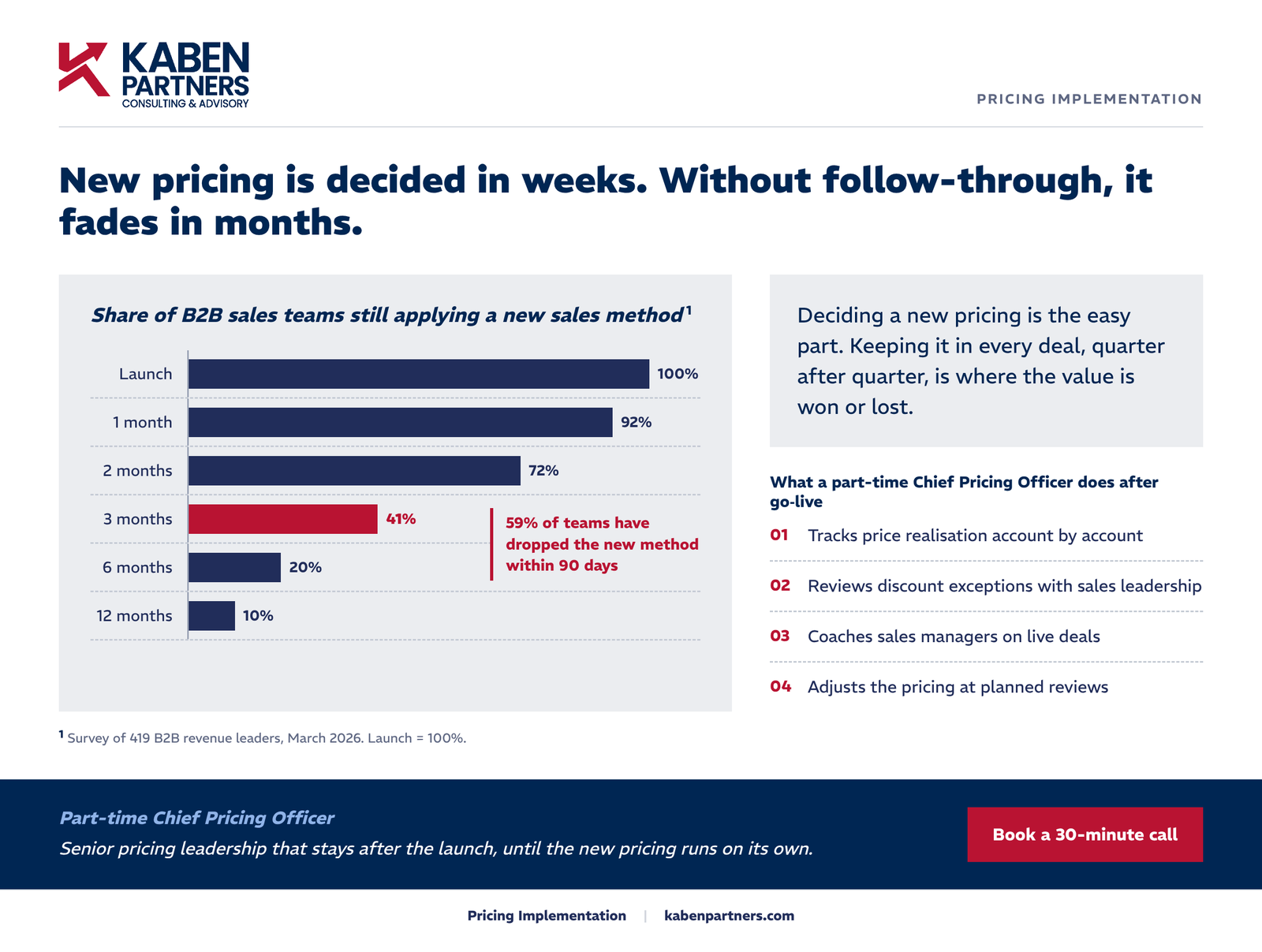
Deciding on a new pricing takes weeks. Embedding it in every deal takes months. A 2026 survey of 419 B2B revenue leaders found that 59% of new sales methods fade within 90 days of launch, and only one team in ten is still applying them a year later. Pricing is no exception: without follow-up, former discounting habits return, one exception at a time.
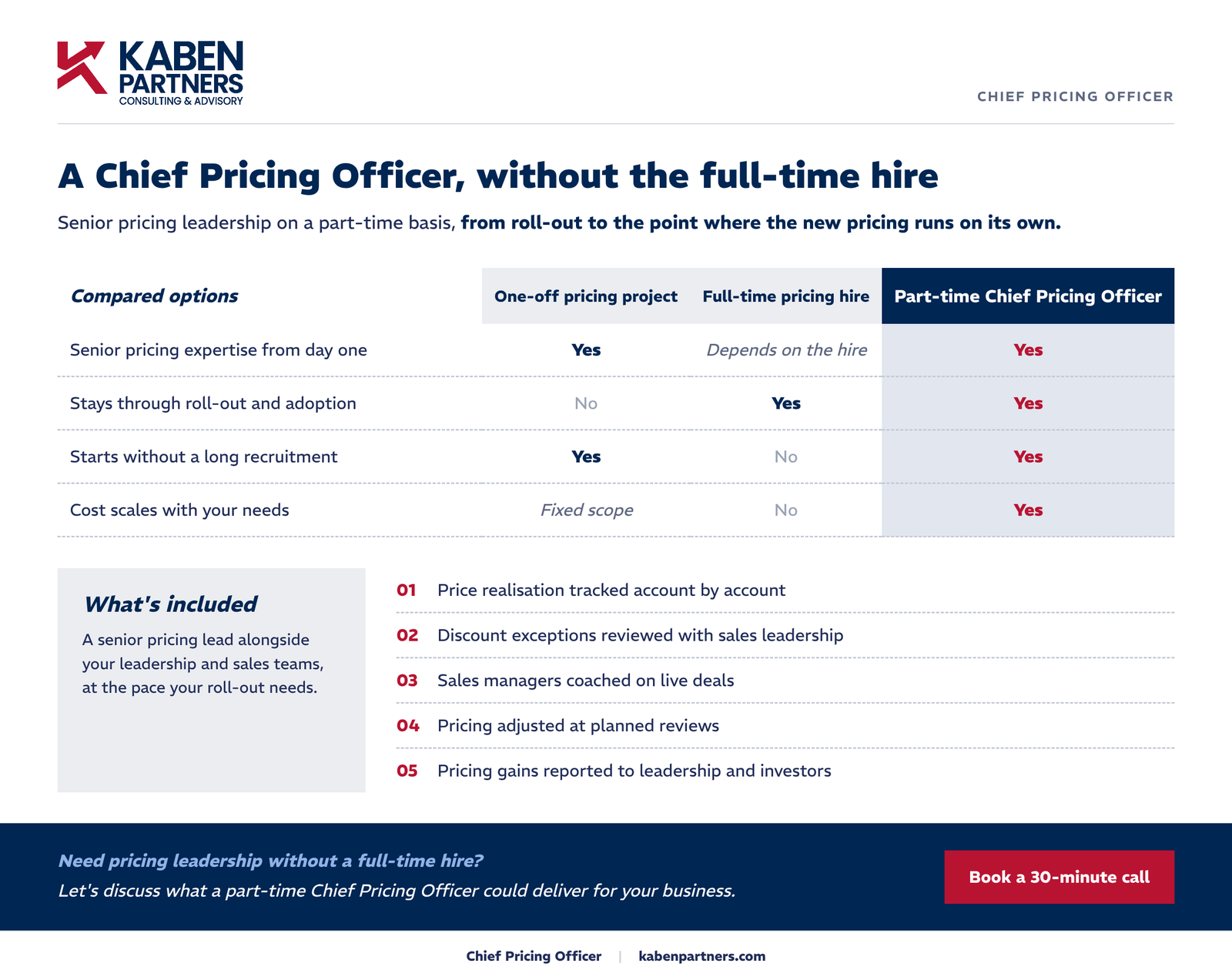
This is why I do not stop at the recommendations. As a part-time Chief Pricing Officer, I work alongside the leadership and sales teams through the roll-out and beyond: tracking price realisation account by account, reviewing exceptions with the deal desk, coaching managers, and adjusting the pricing at planned intervals.
Above all, a pricing expert provides the backbone the change needs to hold its course. That means saying no when it matters: to sales requests that would reopen the decision, but also to management when a decision is not reasonable or no longer serves the objectives it set itself. It also means having the right arguments ready when the sales team pushes back, so that the direction remains clear. Listening does not stop. What stops is renegotiating the decision deal by deal.
Support over time
Deciding a new pricing takes weeks. Embedding it in every deal takes months.
KABEN Partners
Key takeaways
Do not seek consensus. Pricing aligns functions with different objectives; the right decision is the one that serves revenue, margin and lifetime value.
Expect dissent. People align easily on abstract principles; actionable pricing decisions will always generate more debate.
Listen to sales early. Their field knowledge improves the pricing.
Check what they say against the market. Internally, price sensitivity is almost always overestimated.
Do not let sales set prices. Pricing is a distinct profession, and full sales autonomy on price destroys margin.
Decide on impact. Estimate every decision’s effect on leads, conversion, revenue, volume and lifetime value.
Convince before you impose. A convinced salesperson sells the price; an unconvinced one negotiates it away.
Set a go-live date and hold it. If you wait for unanimous agreement, you will never go live.
Support the change over time. New behaviours fade within weeks without follow-up.
Frequently asked questions
Should pricing decisions be made by consensus?
No. Pricing should bring together the perspectives of finance, marketing and sales, but these functions pursue different objectives. The right decision is the one that best serves the company’s revenue, margin and customer lifetime value objectives, even if it is not popular with every team.
Why do pricing decisions generate more debate than strategic principles?
Because they are actionable. People align easily on abstract concepts such as a vision or a value proposition, which are open to interpretation and change nothing immediately. A pricing decision has direct consequences for customers, sales teams and results. Dissent is therefore expected and should not be read as a sign that the project is failing.
Should salespeople have pricing authority?
Limited authority, yes. Research on B2B firms shows that moderate delegation works best: salespeople can adapt a deal within defined price corridors, while list prices, discount policies and larger exceptions are decided by a pricing function working with sales, marketing and finance.
How do you get a sales team to accept new pricing?
Involve them early by listening to their feedback during the audit, explain the reasoning, data and expected impact behind the decisions, give them the tools to present the pricing to customers, and set a clear go-live date after which the new pricing applies to everyone.
What if some salespeople still disagree after go-live?
Keep listening and track results, but do not reopen the decision deal by deal. Enforce the guardrails and approval process, and make sure leadership supports the policy when customers push back.
What does a part-time Chief Pricing Officer do?
A part-time Chief Pricing Officer brings senior pricing expertise without a full-time hire: they steer the roll-out of a new pricing, track price realisation, govern discount exceptions and coach sales managers over several months, until the new practices are embedded.
Is your sales team negotiating your margin away?
KABEN Partners helps B2B leadership teams and private equity-backed companies design pricing, realign sales incentives and bring sales teams on board to win at higher margins.